Yes, you can sue your employer for not paying your bonus, but whether you win depends on one threshold question: was the bonus contractually earned, or was it left entirely to your employer’s discretion?
J. Ashwin Madia, founder of Madia Law LLC and a Fellow of the American College of Trial Lawyers, has represented Minnesota employees against some of the state’s largest corporate employers. We have recovered multi-million dollar verdicts for workers whose earned compensation was withheld, including a $2.4 million settlement in a wrongful termination and retaliation case. When a promised bonus disappears after you have met every condition required to earn it, that is not a business decision. It may constitute wage theft.
Our attorneys explain when unpaid bonuses are legally enforceable in Minnesota, what claims you can bring, and what steps to take right now.
- A bonus written into your offer letter, employment contract, or company policy is legally enforceable as earned wages under Minnesota law.
- Discretionary bonuses, such as gifts or holiday payments decided entirely at the employer’s discretion, are generally not enforceable in court.
- Minnesota wage statutes (Minn. Stat. §§ 181.13 and 181.14) require employers to pay all earned wages, including promised bonuses, within 24 hours of discharge or by the next regular pay period after resignation.
- If your employer withheld a bonus after firing you, you may have both an unpaid wages claim and a wrongful termination claim running simultaneously.
- Minnesota’s statute of limitations on wage claims and breach of contract claims means delays in taking action reduce your recovery options. An employment lawyer in Minneapolis can review your situation and advise you on the next steps.
Is a Promised Bonus Legally Enforceable?
A bonus is legally enforceable when your employer committed to pay it in writing or through a clear, established policy tied to specific conditions you met. Courts treat these as contractual obligations, and in Minnesota, they qualify as earned wages under state wage law.
A bonus becomes enforceable when at least one of these conditions exists:
- Your offer letter or employment contract specifies a bonus amount or formula.
- A company policy or handbook describes a bonus program with defined eligibility criteria.
- Your employer made a written or documented verbal commitment, and emails, Slack messages, or performance plans all count.
- The bonus is tied to measurable targets such as sales quotas, revenue thresholds, or project milestones that you achieved.
When you satisfy those conditions, the bonus is no longer a gift. It is earned compensation. Withholding it exposes your employer to claims under both breach of contract theory and Minnesota wage law. Our unpaid wages attorneys handle exactly these disputes for employees across Minneapolis and the Twin Cities.
One phrase to watch for in your agreement is “at the employer’s sole discretion.” That language, if present, shifts a bonus from contractual to discretionary and significantly weakens enforceability. Whether that language actually controls your situation depends on how the bonus was communicated and administered in practice, which is something an attorney needs to evaluate with your specific documents in hand.

Ready To Talk? Contact Madia Law Today
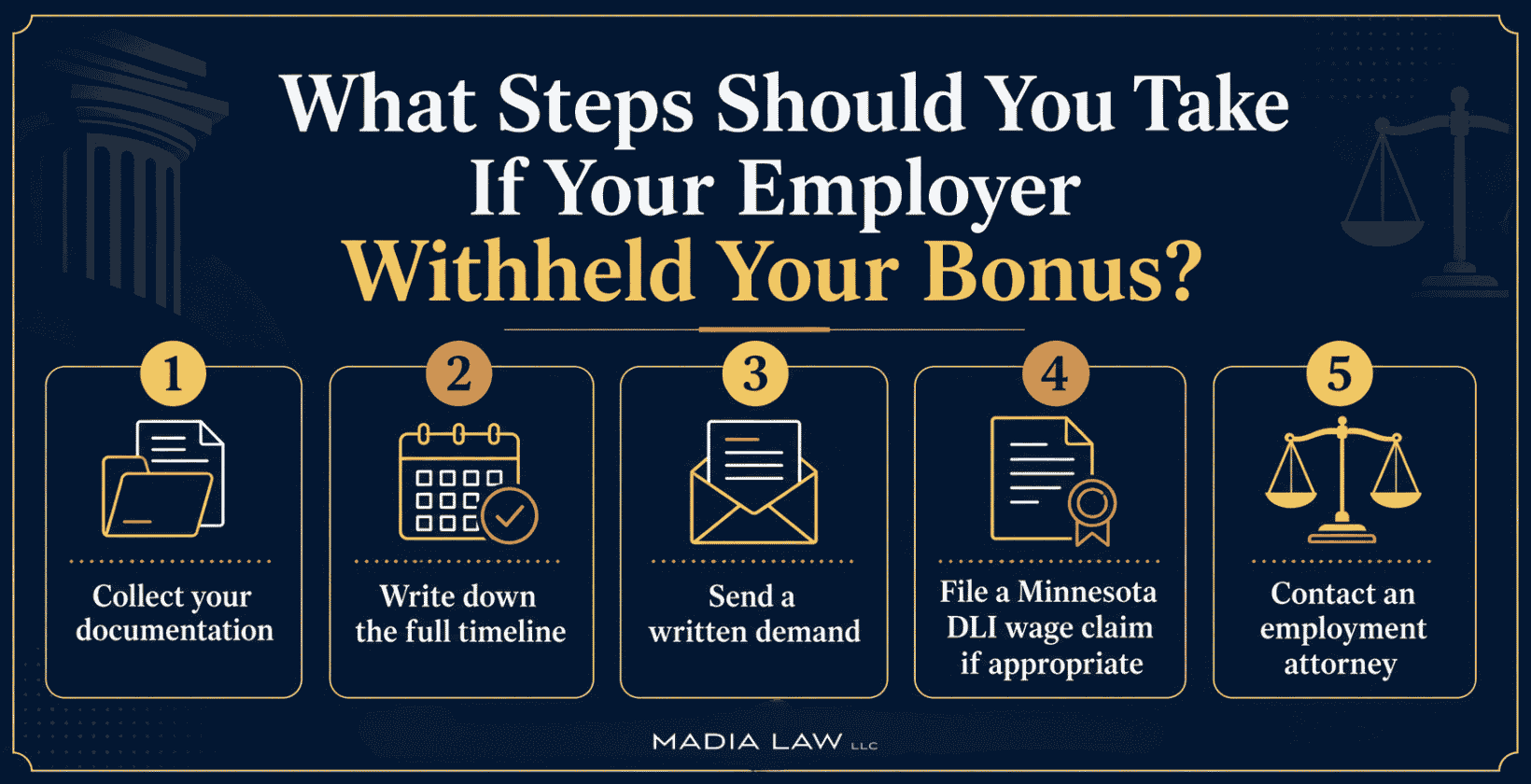
What Steps Should You Take If Your Employer Withheld Your Bonus?
Gather your documentation, make a written demand, and contact a Minneapolis employment attorney before the statute of limitations expires on your wage and contract claims.
- Step 1: Collect your documentation: Pull together every document that references your bonus, including your offer letter, employment contract, company policy handbook, bonus plan documents, performance reviews, emails from management confirming targets were met, pay stubs, and any communication in which your employer acknowledged the bonus was owed. The stronger your paper trail, the stronger your claim.
- Step 2: Write down the full timeline: Record when the bonus was promised, what conditions were attached, when you met those conditions, when payment was supposed to be made, and when your employer told you it would not be paid. Precise dates matter in litigation.
- Step 3: Send a written demand: Under Minn. Stat. § 181.13, making a written demand starts the 24-hour payment clock and the 15-day penalty wage clock. Send your demand by email and certified mail on the same day, and keep confirmation of delivery.
- Step 4: File a Minnesota DLI wage claim if appropriate: The Minnesota Department of Labor and Industry accepts wage claims at no cost. This is appropriate for straightforward unpaid amounts. It does not recover penalty wages, attorney’s fees, or retaliation damages, which is why many employees pursue both the DLI process and a civil lawsuit simultaneously.
- Step 5: Contact an employment attorney: A lawsuit recovers everything the DLI process cannot. J. Ashwin Madia has tried over 100 cases and represented employees against Fortune 500 companies, government entities, and major Minneapolis employers. Our firm works on contingency, so there are no legal fees unless there’s a recovery. Read about how Madia Law builds a case.
What Is the Difference Between a Discretionary and Nondiscretionary Bonus?
A nondiscretionary bonus is earned when you hit a pre-set target. A discretionary bonus is a gift the employer can give or withhold for any reason. Only nondiscretionary bonuses are legally enforceable as wages.
The U.S. Department of Labor and the Fair Labor Standards Act (FLSA) draw a clear line between these two types. Understanding which category your bonus falls into determines whether you have a legal claim.
| Bonus Type | Legally Enforceable? | Common Examples |
|---|---|---|
| Nondiscretionary | Yes | Attendance bonuses tied to a defined number of hours worked; performance bonuses linked to measurable sales or revenue targets; sign-on bonuses with a retention period you completed; retention bonuses tied to a specific date or milestone. |
| Discretionary | Generally No | Holiday bonuses with no pre-announced criteria; year-end gifts with no stated conditions; spot bonuses given at management’s informal judgment; bonuses described in your agreement as payable “at the company’s discretion.” |
Most commission structures and incentive plans fall on the nondiscretionary side, even when employers try to reclassify them after the fact. If your employer announced the bonus plan, communicated the criteria, and you met those criteria, a court is likely to treat the bonus as nondiscretionary regardless of what the employer calls it now.
Minnesota law also affects how nondiscretionary bonuses interact with overtime pay. Under the FLSA, nondiscretionary bonuses must be included in the regular rate of pay used to calculate overtime. If you worked overtime in the same period a bonus was earned, your employer may owe additional overtime on top of the unpaid bonus. This applies to non-exempt employees only. If your classification is unclear, the exempt and non-exempt employee guide walks through how employers and courts draw that line.
Not Sure Where To Start? Contact Us
What Does Minnesota Law Say About Unpaid Bonuses?
Miss the deadline, and it costs you. Under Minn. Stat. § 181.13, an employer who fails to pay earned wages within 24 hours of a written demand owes one additional day’s pay for every day of nonpayment, capped at 15 days. Under § 181.14, resigned employees are owed any bonus compensation that vested before their last day by the next regular pay period.
Minnesota has no statute devoted exclusively to bonuses, but when a bonus qualifies as earned wages under the nondiscretionary test, state law fully protects it. These deadlines are not suggestions.
The 24-hour clock starts from your written demand, not your last day of work. Send it by email and certified mail on the same day to create a clear, dated record.
The Minnesota Department of Labor and Industry (DLI) accepts wage claims at no cost but covers only the unpaid amount. A civil lawsuit also recovers penalty wages, attorney’s fees, and potentially punitive damages. Unpaid wages and commissions in Minnesota cover both tracks and what each one recovers.
Contact Madia Law Before You Decide Anything
What Legal Claims Can You Bring for an Unpaid Bonus?
An unpaid bonus claim in Minnesota can be pursued as a breach of contract, a wage theft violation, a retaliation claim, or a wrongful termination claim. In many cases, more than one theory applies simultaneously, and layering claims is what creates real leverage.
- Breach of Contract: If your bonus was written into an offer letter, employment agreement, or company policy, your employer’s failure to pay is a breach. Courts have enforced bonus commitments found in offer letters, onboarding emails, and handbooks, even where the document was never formally titled “employment contract.”
- Wage Theft Under Minnesota Law: Earned bonuses are wages under Minnesota law. Withholding them triggers statutory penalties on top of the unpaid amount, and the employer bears your attorney’s fees if you prevail.
- Retaliation: If your bonus was withheld after you reported harassment, discrimination, or any other protected activity, the nonpayment may constitute illegal retaliation in its own independent claim on top of the wage claim. Madia Law LLC recovered $2.4 million in a case where an employee was terminated and denied earned compensation after reporting gender discrimination. Speak with a Minneapolis retaliation attorney as soon as possible.
- Wrongful Termination: If you were fired specifically to prevent a bonus from vesting, the termination itself may be wrongful under Minnesota law. Courts have recognized this as a breach of the employment contract where bonus terms were documented in an offer letter, compensation agreement, or company policy.

How Long Do You Have to File?
Minnesota’s statute of limitations varies by the type of claim, and the clock runs from the date wages were due, not the date you discovered they were withheld.
Wage claims under Minn. Stat. § 541.07 carry a two-year filing deadline. That period extends to three years if the nonpayment was willful or if your employer refused to produce payroll records when the Department of Labor and Industry requested them. A bonus withheld after you met every stated condition is a strong candidate for the willful standard.
Breach of contract claims under Minn. Stat. § 541.05 carry a six-year deadline from the date of the breach.
Because most unpaid bonus cases involve both a wage claim and a contract claim running simultaneously, the practical filing window is two years from when payment was due, not six. Waiting to see if your employer pays voluntarily costs you the wage claim’s statutory penalties, even if the contract claim survives. An employment attorney can tell you exactly which deadlines apply to your specific situation.
What Damages Can You Recover in an Unpaid Bonus Lawsuit?
Most withheld bonus cases recover the unpaid amount, penalty wages of up to 15 days’ pay, and attorney’s fees. When the bonus was withheld as retaliation for reporting discrimination or misconduct, the damages picture shifts significantly. Back pay, front pay, emotional distress, and punitive damages all come into play, and that combination is what creates real settlement leverage before trial.
Under Minnesota wage statutes (§§ 181.13 and 181.14):
- The full unpaid bonus amount
- Penalty wages: one day’s pay per day of non-payment, up to 15 days
- Attorney’s fees, meaning the employer pays your legal costs if you win
- Court costs
Under a breach of contract claim:
- The full bonus amount plus pre-judgment interest
- Consequential damages if the nonpayment caused additional financial harm
Under a retaliation claim, when the withholding was punishment for a protected activity:
- Back pay covering lost wages from the date of the adverse action
- Front pay covering future lost earnings
- Lost benefits and compensation
- Emotional distress damages
- Punitive damages in cases of intentional, malicious conduct
- Attorney’s fees
Calculating damages in employment cases covers how attorneys put a number on it.
Can Your Employer Withhold Your Bonus After Firing You?
No. If you earned a bonus before your discharge date, your employer cannot withhold it simply because you are no longer employed. Minn. Stat. § 181.13 requires payment of all earned wages, including bonuses, within 24 hours of a written demand following discharge.
The most common scenario: an employee hits their annual sales target in Q3, gets terminated in November before the scheduled Q4 payout, and the employer claims the bonus is void because the employee was not on payroll on the payment date. Minnesota courts have rejected that argument where the bonus was earned before termination.
The legal question is whether the bonus vested before your last day. Vesting occurs when you satisfy all pre-stated conditions, hitting the target, completing the performance period, or reaching the tenure threshold. Once vested, it is earned wages, and termination cannot forfeit it.
If you were fired shortly before a large bonus payment, that timing is itself evidence. Courts and juries in Minnesota recognize this pattern, and depending on the surrounding facts, it may support a wrongful termination claim alongside your wage claim. Either way, the clock on your filing deadline is already running.
Madia Law LLC Fights for Minnesota Employees Whose Bonuses Were Withheld
We are a Minneapolis plaintiff-side trial firm that represents employees exclusively, never employers. J. Ashwin Madia brings over 100 tried cases and a Fellowship in the American College of Trial Lawyers to every wage dispute we handle.
Most claims settle before trial because the employer knows the attorney on the other side is prepared to take the case to a jury. Every case at Madia Law is built for trial from day one. Our lawyers handle unpaid bonus cases on contingency. No legal fees unless we recover for you, and we advance all litigation costs from day one.
Results relevant to unpaid compensation and retaliation:
- $3 million wrongful termination and retaliation, resolved two weeks before trial.
- $2.4 million employee terminated after reporting gender discrimination, and earned compensation was denied.
- $2.1 million jury verdict for retaliation and race discrimination.
- $1.1 million whistleblowers whose compensation was withheld after reporting financial misconduct.
We serve employees across the Twin Cities metro, including Minneapolis, St. Paul, Edina, Plymouth, Maple Grove, and Minnetonka.
Frequently Asked Questions About Suing Your Employer for an Unpaid Bonus
Is a Verbal Promise of a Bonus Legally Binding in Minnesota?
Yes, a verbal promise of a bonus is legally binding when supported by follow-up documentation such as emails, performance plans, or Slack messages. Minnesota courts have enforced verbal bonus commitments where conditions were specific, and the employee demonstrably met them.
Can My Employer Change the Bonus Terms After I Have Already Earned It?
No, your employer cannot change bonus terms after you have already earned the bonus. Once you satisfy all stated conditions, it vests as earned wages under Minnesota law. Any retroactive modification is unenforceable and may constitute wage theft.
How Do I Prove My Employer Owes Me a Bonus?
To prove your employer owes you a bonus, document the promise in writing, the conditions attached, and evidence you met those conditions. Offer letters, performance reviews, emails from management, and pay stubs are the strongest proof in a wage dispute.
Does an Unpaid Bonus Affect My Overtime Pay?
Yes, an unpaid nondiscretionary bonus directly affects your overtime pay. Under the FLSA, nondiscretionary bonuses must be included in your regular rate of pay, meaning your employer may owe additional overtime on top of the withheld bonus amount.
Can I Sue for a Bonus After Signing a Severance Agreement?
It depends on the severance agreement’s language. A general release of claims typically bars a bonus lawsuit unless the bonus was explicitly carved out. An attorney must review the agreement’s scope before you waive any rights to unpaid compensation.
Start the Conversation With Madia Law LLC Today
If your employer withheld a bonus you earned, you have legal options, and the clock on your claim is already running. Madia Law LLC represents workers across Minneapolis and the Twin Cities metro on a contingency basis. The first conversation is with a trial lawyer directly, not an intake coordinator, and we advance all litigation costs from day one.

Call 612-349-2729 or reach out to Madia Law LLC online to talk through what happened and find out whether you have a claim worth pursuing.
J. Ashwin Madia and the firm’s attorneys, Zane A. Umsted and Anna Mitchell, are ready to review what happened and tell you exactly where you stand.
Prior results do not guarantee a similar outcome. Every case is unique, and the value of any claim depends on its specific facts.
Our Minneapolis Employment Law Office
You Don't Have To Face This Alone. Call 612-349-2729.