



Why Hire Our Minneapolis Drug and Alcohol Testing Attorney?
 Top 1% of Trial Advocates
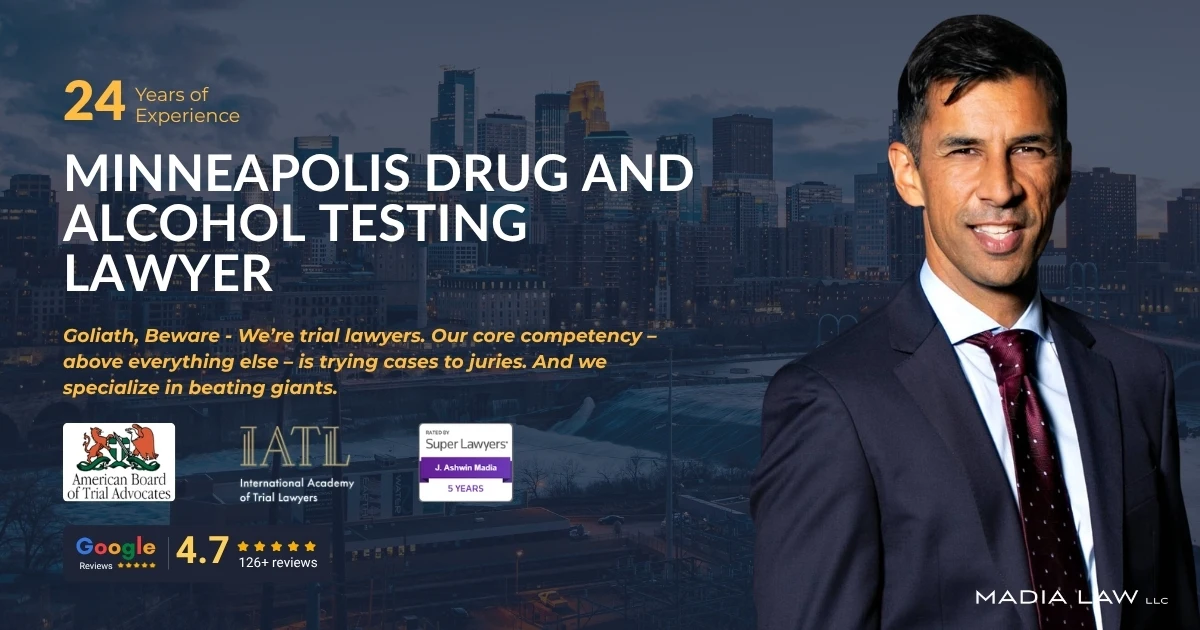
Founder J. Ashwin Madia is a Fellow of the American College of Trial Lawyers, the International Academy of Trial Lawyers, and the American Board of Trial Advocates.
 Built on 100+ Trials of Experience
Before founding Madia Law, Ashwin Madia tried more than 100 felony and misdemeanor cases as a U.S. Marine Corps judge advocate.
 Giants Pay. Clients Recover.
Every dollar recovered started with a defendant who knew we were ready to try the case.
 We Take Fewer Cases.
Selective intake means every case gets serious attention. We prepare matters to be tried, not simply filed and forgotten, because giants take prepared trial lawyers seriously.
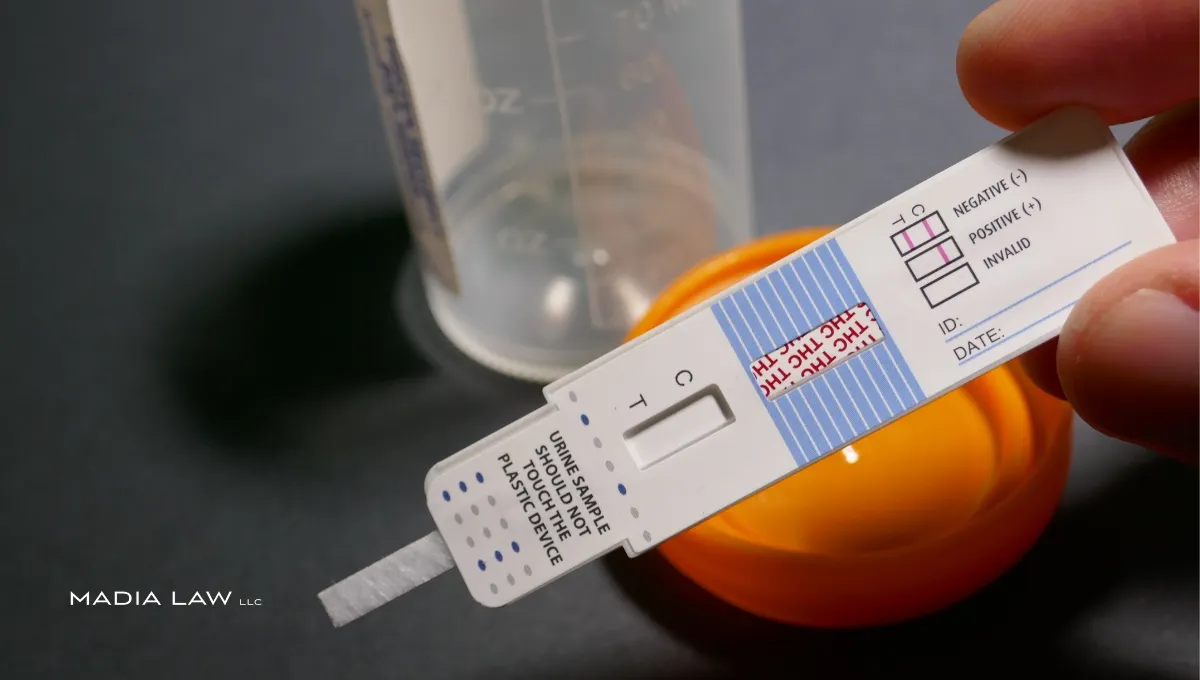
A positive drug test doesn’t automatically end your job in Minnesota. Under the state’s Drug and Alcohol Testing in the Workplace Act, widely regarded as one of the strictest workplace drug testing laws in the country, a first positive result can’t lead to termination unless your employer offers you a real chance at treatment first. Most people fired the same day they test positive never hear that part.
Founder Ashwin Madia has spent 17 years holding Minnesota employers accountable under laws like DATWA. That track record includes millions recovered for Minnesota employees across documented case results, among them a $500,000 settlement in a DATWA wrongful termination case.
If your employer tested you outside DATWA’s rules, disciplined you before your confirmatory test came back, or skipped the required treatment offer, our Minneapolis employment lawyer will investigate what happened and hold your employer to the law’s requirements.
Contact us today at 612-349-2729 or fill out the form to schedule a case consultation.





Featured Case Result
$500,000
– Fired After One Positive Test. No Offer of Treatment
Our client had worked at the same Minnesota company for ten years when a random drug test came back positive for marijuana, the first positive test of his career there. His employer fired him on the spot, without ever offering him the treatment DATWA requires before a first positive test can lead to termination.
We proved his job wasn’t safety-sensitive, meaning he was legally entitled to that chance at treatment. The company settled for $500,000.
Attorney advertising. Prior results do not guarantee a similar outcome. Every case is unique, and the value of any claim depends on its specific facts.
5 Ways an Employer Can Legally Require Testing
DATWA doesn’t give employers a free hand to test whenever they want. Testing is only lawful in five specific situations, and if your employer tested you outside of these categories, that alone may be a violation worth a conversation with a lawyer.
- Job applicant testing. Only after a conditional job offer has been made, and only if the same test is required of every applicant offered that same position.
- Routine physical examination testing. No more than once per year, and only with at least two weeks’ written notice that a test may be part of the exam.
- Random testing. Limited to employees in safety-sensitive positions, or to professional athletes under a collective bargaining agreement that permits it.
- Reasonable suspicion testing. Allowed if the employer reasonably suspects you’re under the influence at work, have violated a written drug or alcohol policy, or have been involved in a workplace injury or accident.
- Treatment-referral and return-to-duty testing. Allowed if you were referred for chemical dependency treatment, or you’re participating in a treatment program under a benefit plan, including follow-up testing for up to two years afterward.
Outside of these five categories, DATWA also protects you on the back end: employees who report unlawful testing or discipline can’t be punished for it, and an employer can never test you, or any employee, on an arbitrary and capricious basis. If you believe you’ve been retaliated against for speaking up about unlawful testing or workplace discipline, you may have legal options worth exploring with a Minneapolis retaliation lawyer.
Ready To Talk? Contact Madia Law Today
Requirements Employers Must Follow for Drug and Alcohol Testing
Minnesota’s Drug and Alcohol Testing in the Workplace Act (DATWA), codified at Minn. Stat. §§ 181.950 to 181.957, puts specific requirements in place for employers who choose to test employees or job applicants. The core authorization rules sit in § 181.951, the minimum content required in a written policy is set out in § 181.952, and the lab and notice procedures are in § 181.953. If an employer fails to follow these rules, a drug and alcohol testing attorney in Minneapolis can help you pursue legal action. These requirements for employers include:
Providing Notice to Employees
Employers must provide employees with a written notice of their drug and alcohol testing policy that includes information about:
- Which employees or job applicants are subject to testing
- The circumstances under which testing can be requested or required
- The rights of an employee or job applicant to refuse testing and any related consequences
- The consequences of testing positive
- Any appeals procedure that can be pursued
Using a Licensed, Accredited, or Certified Lab
When testing employees for drugs and alcohol, employers are required to use a reliable, certified lab for drug testing with procedures in place to ensure the chain of custody is not broken and that the results are as accurate as possible. Employers cannot conduct their own testing of employees.
Informing Employees of Their Rights
Before any test, your employer must give you a form to sign acknowledging you’ve read the testing policy. If you test positive, your employer must notify you in writing of your right to explain the result. You can disclose prescription medications relevant to the result. You can request a confirmation test on your original sample within five working days of notice.
Once the lab reports your result, your employer has three working days to notify you in writing and explain these rights.
For a broader look at how these rules apply across Minnesota workplaces, see our overview of the state’s drug and alcohol testing laws.
Contact Madia Law To Discuss Your Case.
Can a Positive Test Result in Termination of Employment?
Testing positive doesn’t automatically mean you lose your job. Minnesota law builds in strict protections that your employer must follow before any discipline, up to and including termination, can happen.
First, you have the right to request a copy of your test results. Any initial positive screening must be verified by a secondary “confirmatory” test before your employer can act on it. Once you are notified of a positive confirmatory result, you have five working days to request a confirmatory retest of the original sample at your own expense. If that retest comes back negative, your employer cannot discipline you.
Even if the positive result is fully verified, your employer still cannot immediately fire you if this is your first positive result on the job. Instead, they must first offer you the opportunity to participate in a drug or alcohol counseling or treatment program. You can only be terminated if you refuse that offer or fail to complete the program. A second or subsequent confirmed positive test removes these protections, allowing your employer to fire you for cause.
If your employer skipped any of these steps, whether they disciplined you before the confirmatory result came back, denied you a real chance at treatment on a first offense, or violated your rights during the testing process itself, you may have grounds for a wrongful termination claim.

Not Sure Where To Start? Contact Us
Who DATWA Does Not Protect
A small number of Minneapolis employees fall outside DATWA because federal law already occupies the field for their type of work. Under Minn. Stat. § 181.957, these categories are governed by federal testing rules instead:
| If You Work As a | You’re Covered Instead by |
|---|---|
| Commercial drivers (CDL holders) | U.S. DOT / Federal Motor Carrier Safety Administration FMCSA drug and alcohol testing rules |
| Railroad workers in safety-sensitive service | Federal Railroad Administration (FRA) testing rules |
| Pipeline workers in safety-sensitive service | Pipeline and Hazardous Materials Safety Administration (PHMSA) testing rules |
| Aviation personnel in safety-sensitive positions | Federal Aviation Administration (FAA) testing rules, which fully preempt DATWA for this group |
| Commercial vessel and transit workers | U.S. Coast Guard or Federal Transit Administration testing rules |
If you don’t fall into one of these categories, DATWA almost certainly applies to you, and it’s worth having a lawyer confirm that rather than assuming either way.
Contact Madia Law Before You Decide Anything
What Is a Drug or Alcohol Testing Claim Worth?
There’s no single “average settlement” for a DATWA case, because the value depends on the same factors that drive any employment case: the strength of the case on the merits, the damages you’ve suffered, whether your employer can pay, and your own tolerance for risk. We break down how we calculate what a case is worth in more detail, but here’s what that can look like in practice.
In the case above, a ten-year employee fired after one positive test, with no offer of treatment, recovered $500,000. Every case is different, and past results don’t guarantee any future outcome, but real numbers like this one are far more useful than a vague estimate.
Damages in a DATWA case can include back pay for wages already lost, front pay for expected future losses, emotional distress damages, and, in many cases, your attorney’s fees and costs. Getting your job back is sometimes possible, depending on the circumstances.
How Long Do I Have to File a DATWA Claim in Minnesota?
In Minnesota, employees who lost their jobs due to violations of Minnesota’s DATWA regulations have six years from the date of the unlawful action to file a lawsuit against their employer. If you miss the filing deadline, you will likely be out of options for pursuing damages.
Speaking with an experienced drug and alcohol testing attorney serving Minneapolis as soon as possible is the best way to ensure that all your paperwork gets filed on time and that your right to recover compensation is protected.
What to Do If You Were Just Fired After a Drug or Alcohol Test
If you’re reading this because it just happened to you, we’re sorry you’re dealing with it. A few concrete steps now can make a real difference in whether you have a strong case later.
- Elect COBRA continuation coverage promptly if your former employer’s plan qualifies, so you and your family stay covered for health insurance while you sort out the next steps.
- Write down everything while it’s fresh: the date, who fired you, exactly what reason you were given, and who else was present.
- Don’t sign a severance or separation agreement before a Minnesota employment lawyer has reviewed it. Signing away your right to sue is often part of that paperwork.
- Send a written request for your personnel file and a written request for the specific reason for your termination. Minnesota law entitles you to both, and a written answer is harder for an employer to change later.
We’ve outlined what to do after being fired in more detail, including sample request language you can send today.
★★★★★
“To put it simply: Madia Law is an A+ organization. Ashwin and his team supported me on an employment case, and while it was a long shot to begin with, they went above and beyond what I expected. Throughout the entire process they were very responsive, communicative, and ethical.
If I ever run into a situation again they’ll be my first call!”
Frequently Asked Questions
Can My Employer Test Me Without Any Notice at All?
No. DATWA requires a written testing policy, acknowledged by the employee in advance, before any test occurs. Routine physical exam tests need two weeks’ written notice. Reasonable suspicion and post-accident tests skip that specific notice, but the written policy exists before testing starts.
Can I Refuse a Drug Test in Minnesota?
Yes, an employee can refuse a drug or alcohol test under DATWA. Refusal carries consequences equal to a positive result: an employer can discipline or terminate an employee who refuses testing, using the same confirmatory-test and treatment-offer rules that apply to a confirmed positive. Refusal does not eliminate DATWA’s procedural protections.
What If I Tested Positive Because of Legal Medical Cannabis Use?
Minnesota’s medical cannabis program interacts with DATWA in ways that are still developing and highly fact-specific. A positive test connected to legal medical cannabis use doesn’t automatically protect your job, but it can change how your employer is required to handle the situation and whether any discipline was lawful. This is exactly the kind of question worth a direct conversation with an attorney rather than guessing from a general article.
Does DATWA Apply If I Work as an Independent Contractor?
Yes. DATWA defines “employee” and “job applicant” broadly enough to include independent contractors. The same notice, policy, and confirmatory-test rights apply to a contractor tested under an employer’s drug and alcohol testing policy. Classification disputes still arise, so a Minneapolis employment lawyer can confirm how DATWA applies to your specific arrangement.
What Happens If My Employer Never Had a Written Testing Policy?
Under Minn. Stat. § 181.951, an employer cannot request or require testing at all unless it’s done under a written policy that meets the minimum content requirements in Minn. Stat. § 181.952. Testing conducted without that policy in place, or testing that doesn’t follow the policy’s own terms, is one of the more common and more provable DATWA violations.
Speak to Our Drug and Alcohol Testing Lawyer Today
After being subjected to unlawful drug and alcohol testing or being terminated in violation of the DATWA regulations, recovering compensation can be critical for getting your life back on track. At Madia Law, we have a long history of helping employees protect their rights against employers who violate them.
You don’t need to have everything figured out before reaching out. Call us at 612-349-2729 or request a case review online. You can also visit us at our office at IDS Center, 3075, 80 S 8th St, Minneapolis, MN 55402.
Our Minneapolis Employment Law Office
You Don't Have To Face This Alone. Call 612-349-2729.