If you are concerned that something may have happened to a loved one in a nursing home, you are likely looking for answers and a path forward. Many Minnesota families have faced similar concerns and taken steps to protect their loved ones and pursue justice with confidence.
At Madia Law LLC, we bring strength, clarity, and compassion to every nursing home and group home abuse case we handle. From our office in Minneapolis, our trial lawyers work closely with families to uncover the facts and hold negligent facilities fully accountable. If you are ready to take the next step, we are here to guide you.
Contact us today to start the conversation.





How a Minneapolis Nursing Home Abuse Lawyer Helps Your Case
A Minneapolis nursing home abuse lawyer helps your case by protecting your loved one’s rights, gathering evidence, and holding the facility accountable. Legal guidance is essential when institutions deny wrongdoing, delay action, or hide critical records.
With experience handling trauma cases, we act quickly to uncover the truth, preserve evidence, and push for justice through settlement or trial.
Investigating Sexual Misconduct Claims with Discretion and Detail
To prove elder sexual abuse, we begin with a private, thorough investigation. This includes collecting facility records, staff logs, and surveillance footage, all while respecting the resident’s dignity and privacy. We interview staff and other residents discreetly to preserve confidentiality and reduce trauma. Every step is handled with professionalism and compassion.
Securing Medical and Psychological Evidence to Support the Allegation
Medical and psychological evaluations are critical in elder sexual abuse cases. We work with geriatric physicians to document injuries and trauma psychologists to assess emotional harm. For example, a sudden onset of fear or withdrawal, paired with medical findings, can validate claims even when a resident can’t speak for themselves.
Identifying Patterns of Abuse and Institutional Cover-Ups
Repeated abuse, frequent staff reassignments, or past complaints ignored by management may signal a deeper pattern of negligence. We examine the facility’s history to detect these red flags. In one case, internal emails showed the nursing home dismissed a similar complaint months earlier, evidence that strengthened our client’s civil claim.
Building a Survivor-Centered Legal Strategy for Maximum Impact
We design every case strategy to protect the survivor’s privacy, mental health, and long-term well-being. Using trauma-informed legal practices, we minimize re-traumatization by avoiding unnecessary interviews or exposure. The goal is not just legal success, it’s ensuring survivors feel heard, safe, and in control throughout the process.
Taking Swift Legal Action to Preserve Evidence and Prevent Further Harm
When elder sexual abuse is suspected, time matters. We act quickly to preserve surveillance footage, medical records, and witness accounts before they disappear. Injunctions or emergency reports may be filed to stop ongoing harm. Fast action protects your loved one, and others still in danger, while securing the strongest possible case.
Who Is Liable for Elder Sexual Abuse in Minnesota Nursing Homes?
Liability in nursing home sexual abuse cases is rarely limited to one person. Depending on the facts, responsibility may fall on individual staff, administrators, outside contractors, or the corporations that run the facility.
Understanding where the failure occurred helps build a stronger case. The sections below explain how each party may be held accountable under Minnesota law.
Can Facilities Be Held Accountable for Staff Abuse?
Yes. Nursing homes can be held vicariously liable when staff members commit abuse under their supervision. This includes situations where the facility failed to conduct background checks, ignored past complaints, or allowed unqualified staff to remain employed. Both federal and Minnesota state law require facilities to protect residents from foreseeable harm.
Are Third-Party Contractors or Visitors Also Liable?
Liability can extend to outside actors, such as visiting nurses, contracted aides, or even family members of other residents. When the facility fails to supervise these individuals or ignores warning signs, it may share responsibility. For example, a nursing home may be co-liable if it failed to act on repeated visitor misconduct reports.
How Corporate Ownership May Complicate Liability Claims
Many nursing homes are owned by layered corporations designed to limit financial exposure. These shell structures split operations from ownership, making it harder to sue the true decision-makers. In some cases, we pursue a legal strategy called piercing the corporate veil to hold the parent company directly accountable for negligence.
Who Can File a Sexual Abuse Lawsuit Against a Nursing Home in Minnesota?
If your loved one has experienced nursing home sexual abuse, you may wonder who has the legal right to take action. Under Minnesota law, several individuals or representatives can file a lawsuit depending on the situation, including:
- The resident themselves, if they are able to participate in the case.
- A court-appointed guardian or conservator acting on the resident’s behalf.
- An agent under a valid power of attorney, where the authority to bring legal claims was specifically granted.
- A trustee appointed by the court under Minnesota’s wrongful death statute, if the abuse contributed to the resident’s death (Minn. Stat. § 573.02).
If you are unsure whether you have legal standing, we will help you determine your eligibility and protect your loved one’s rights.
What to Do if You Suspect Elderly Sexual Abuse in a Nursing Home
When something doesn’t feel right, it’s critical to act quickly. Protecting your loved one starts with knowing what steps to take and taking them without delay.
- Document your concerns in writing, including dates, names, and anything you have observed or heard.
- Report the suspected abuse to facility management and request a written response or investigation log.
- Contact Minnesota Adult Protective Services (APS) by calling the Minnesota Vulnerable Adult Abuse Reporting Line at 844-880-1574.
- Secure medical records and any photos or evidence before they can be altered, destroyed, or denied.
- Avoid direct confrontation with suspected abusers, which can increase risk to the resident or compromise a legal case.
- Speak with an experienced elder abuse lawyer to begin preserving evidence and protecting your loved one’s legal rights.
Reports of suspected sexual abuse of a vulnerable adult have to be forwarded immediately to local law enforcement, not just logged with the state (Minn. Stat. § 626.557, subd. 3(b)), so both a criminal investigation and the state’s maltreatment investigation move at the same time.
What’s the Legal Process for a Nursing Home Sexual Abuse Case in Minneapolis?
The legal process in elder sexual abuse cases can be complex, especially when facilities deny wrongdoing or delay cooperation. Working with a lawyer ensures every step is handled with care, speed, and legal precision.
- Initial Call: You speak with our staff about what happened. If we can potentially help, we schedule a call with an attorney to explain your legal options and next steps.
- We launch an immediate investigation to collect records, witness accounts, and physical or digital evidence.
- We file a formal complaint in court, naming the responsible staff, administrators, or corporate entities.
- Both sides exchange evidence in discovery, including depositions, expert opinions, and document production.
- Settlement negotiations may occur if the facility offers compensation before trial.
How Much Compensation Can You Recover in a Nursing Home Sexual Abuse Case?
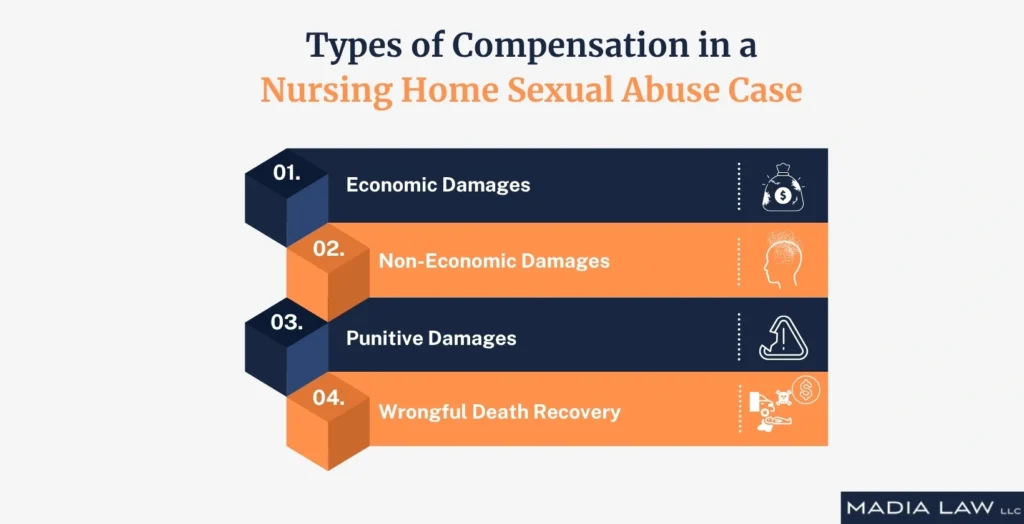
Compensation in nursing home sexual abuse cases is meant to restore what was lost, cover long-term care, and acknowledge the trauma endured. Each case is different, but survivors and families may be entitled to several types of financial recovery.
Recovery generally breaks down into four categories.
- Economic Damages: Medical expenses, long-term care costs, trauma therapy.
- Non-Economic Damages: Pain, suffering, emotional distress, and loss of dignity.
- Punitive Damages: Awarded when the facility acted with deliberate disregard for a resident’s rights or safety, such as ignoring known abuse or covering it up.
- Wrongful Death Recovery: Available if abuse resulted in the resident’s death.
Settlement amounts vary based on factors like the severity of harm, history of prior complaints, facility negligence, and whether intentional misconduct occurred. Our team evaluates these details to pursue the full compensation your family deserves.
Statute of Limitations for Nursing Home Sexual Abuse Claim in Minnesota
Minnesota gives sexual abuse claims their own filing deadline, separate from the general negligence rules (Minn. Stat. § 541.073). A claim against the facility itself, for example, for negligent hiring or supervision that let the abuse happen, generally must be filed within six years of the abuse (subd. 4). A claim brought directly against the person who committed the abuse runs six years from the date your family knew, or reasonably should have known, that the injury was caused by the abuse, which can matter when a resident’s cognitive impairment delayed disclosure (subd. 2).
Because most nursing home sexual abuse claims are brought against the facility rather than only the individual, the six-year-from-the-abuse deadline is usually the one that controls. Acting sooner rather than later still gives us the best chance to preserve staffing records, footage, and witness memory before they disappear.
How Long Does a Nursing Home Sexual Abuse Lawsuit Take in Minnesota
Most nursing home sexual abuse cases in Minnesota are resolved within 6 to 24 months, depending on whether they settle or go to trial. Early legal action and strong evidence can help move the process forward more efficiently.
Delays often happen during the discovery phase if the facility withholds records, disputes facts, or resists cooperation. Other factors like court scheduling, expert availability, and appeals can also extend the timeline. We work to resolve every case as quickly and thoroughly as possible.
What Constitutes Sexual Abuse in a Nursing Home?
Sexual abuse in a nursing home includes any non-consensual sexual contact, behavior, or interaction involving a resident, regardless of physical force. This includes not only physical acts but also verbal harassment, coercion, exploitation, or exposure that violates a resident’s dignity and safety.
Legal Definitions of Sexual Misconduct in Elder Care
Minnesota Statute § 609.341 defines the terms, including sexual contact and sexual penetration, used throughout the state’s criminal sexual conduct laws (Minn. Stat. §§ 609.342–609.345). That same section treats it as an aggravating factor whenever the person accused was a caregiver, facility staff person, or person providing services in a facility, and the resident was a patient or client of that facility (Minn. Stat. § 609.341, subd. 11, cl. (xi)). Minnesota’s Vulnerable Adults Act goes further still: any sexual contact or penetration between a facility staff member and a resident is automatically classified as abuse, whether or not it leads to a criminal charge or conviction (Minn. Stat. § 626.5572, subd. 2(c)). This applies to both physical acts, such as groping or penetration, and non-contact actions like voyeurism, verbal abuse, or forced nudity. Federal elder protection laws reinforce these definitions in licensed care settings.
How Consent, Capacity, and Coercion Are Evaluated
Consent in elder care is only valid when the resident has full mental capacity and is free from manipulation. If a resident suffers from dementia or cognitive decline, they may be legally incapable of giving consent. If a staff member pressures, isolates, or threatens the resident, any claimed consent is considered invalid under Minnesota law.
Common Types of Sexual Abuse Found in Facilities
- Unwanted touching: Physical contact without consent, often disguised as care.
- Groping: Intentional fondling of private areas for sexual gratification.
- Forced nudity: Requiring or exposing a resident unnecessarily without a medical cause.
- Digital penetration: Inserting fingers into body openings without medical justification or consent.
Signs of Sexual Abuse in Elderly Residents
Recognizing the signs of nursing home sexual abuse can help families take action before the harm escalates.
Physical Signs
- Unexplained bruises, bleeding, or swelling in genital areas may indicate inappropriate contact.
- Sudden urinary tract infections or sexually transmitted infections can signal sexual assault.
- Torn or stained undergarments may be overlooked evidence of abuse.
Emotional Signs
- A noticeable increase in fear, anxiety, or depression may reflect trauma.
- Refusal to speak around certain staff members can indicate intimidation or distress.
- Emotional withdrawal or sudden mood swings are common trauma responses.
Behavioral Signs
- Reluctance to be touched or participate in hygiene care may suggest past abuse.
- A sudden change in sleep patterns or appetite could point to psychological impact.
- Uncharacteristic aggression or verbal outbursts may surface as a reaction to fear or violation.
Types of Nursing Home Cases We Handle
Our lawyers have experience in every major type of nursing home abuse case and pursue justice in even the most complex situations.
| Abuse Type | Description |
|---|---|
| Sexual Abuse | Cases involving non-consensual contact, force, or exploitation. |
| Physical Abuse | Hitting, restraining, or inflicting bodily harm on residents. |
| Mental Abuse | Verbal threats, humiliation, or emotional manipulation. |
| Wrongful Death | Abuse or neglect that led directly to the resident’s death. |
| Weight Loss | Malnutrition due to neglect, dehydration, or inadequate care. |
| Medication Errors | Overdosing, missed doses, or incorrect prescriptions causing harm. |
| Financial Abuse | Theft, exploitation, or coercion involving a resident’s money or assets. |
Why Families Choose Madia Law for Nursing Home Abuse Claims
Choosing the right nursing home abuse lawyer can shape the outcome of a nursing home abuse case. Families trust Madia Law because we do not just negotiate; we prepare every case like it’s going to trial.
| Differentiator | Description |
|---|---|
| Trial-Ready Approach | We take cases to court when facilities deny responsibility or lowball victims. |
| Elder Abuse Focus | We handle complex nursing home cases every day, not as a side practice. |
| Aggressive Evidence Strategy | We move fast to secure records, footage, and witnesses before evidence is lost. |
| Direct Attorney Access | Clients work directly with the trial lawyer, not passed off to staff. |
| Respected in Minnesota Courts | Our firm has earned credibility with judges, juries, and opposing counsel. |
| Clear, Honest Communication | We explain your options in plain English, no legal jargon or confusion. |
Speak With a Minneapolis Nursing Home Sexual Abuse Lawyer
If you suspect abuse, do not wait. Acting quickly helps protect your loved one, preserve critical evidence, and hold the facility accountable. Madia Law LLC is ready to review your case and explain your options in a confidential and caring manner.
- Call us today at (612) 349-2729.
- Submit a private case review form on our website.