- It’s About the “Why”: Retaliation occurs when an employer punishes you because you engaged in a protected legal activity, not just because they dislike you.
- You Need Three Elements: To win, you must prove: (1) Protected Activity, (2) Adverse Action, and (3) A Causal Link between the two.
- “Pretext” is the Battleground: Most employers lie about why they fired you. Proving their stated reason is false (pretext) is how we win cases.
- Minnesota Law is Strong: The Minnesota Human Rights Act (MHRA) often provides stronger protections and longer filing deadlines than federal law.
- Don’t Quit Yet: Resigning can hurt your legal standing. Consult a lawyer before making any moves to claim “constructive discharge.”
If you feel like you are being “managed out” or punished after reporting misconduct, you aren’t imagining things. Retaliation is the most frequently filed charge with the Equal Employment Opportunity Commission (EEOC) and a common issue in Twin Cities workplaces. In FY 2024, retaliation accounted for 47.8% of all charges filed nationwide, nearly double the rate of other common claims.
In Minnesota, employment is generally “at-will,” meaning you can be fired for almost any reason or no reason at all. However, there is a massive exception: an employer cannot fire or punish you for asserting your legal rights.
Whether you are facing a demotion, exclusion from meetings, or sudden termination, proving retaliation requires a strategic approach. At Madia Law LLC, we prepare every case as if it is going to trial. This guide explains exactly how to document your experience, prove illegal intent, and protect your livelihood.
What Is Considered Workplace Retaliation?
Workplace retaliation is any adverse action taken by an employer that would dissuade a reasonable worker from supporting or assisting in a discrimination or harassment complaint.
Under both the federal Title VII and the Minnesota Human Rights Act (MHRA), retaliation is strictly prohibited. It is distinct from discrimination; discrimination is about who you are (race, gender, disability), while retaliation is about what you did (reported a safety violation, took FMLA leave, complained about harassment).
The Three Elements of a Retaliation Claim
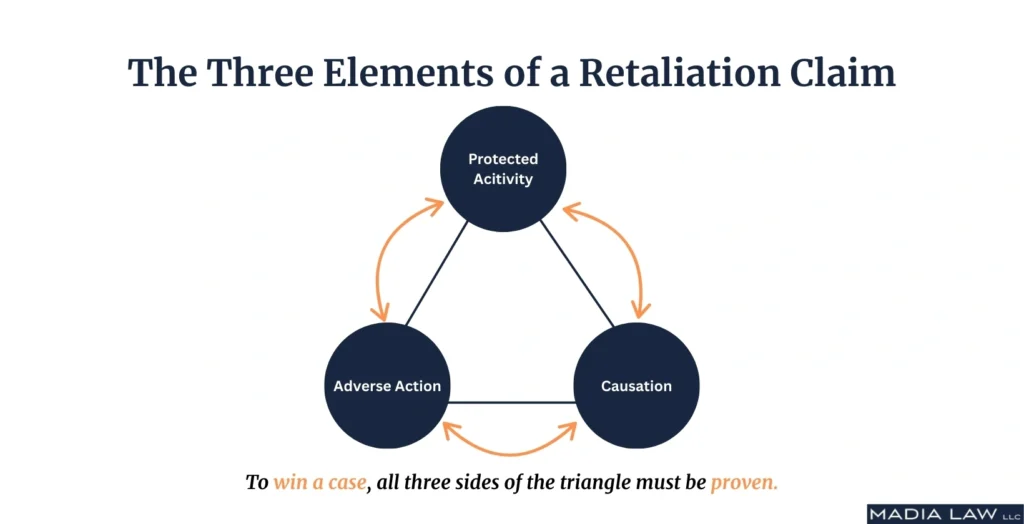
To prove a case in Minnesota courts, we must establish three specific elements:
- Protected Activity: You engaged in legally protected conduct (e.g., reporting sexual harassment).
- Adverse Action: Your employer took action against you that negatively impacted your job (e.g., firing, demotion).
- Causal Connection: There is a link between the two; you were punished because of the protected activity.
For a legal consultation, call 612-349-2729
Protected Activities: What Can You Do Without Fear?
You cannot be retaliated against for exercising your rights. The law categorizes these actions as “Protected Activities.” Crucially, you do not have to be legally correct about the underlying issue to be protected against retaliation; you only need to have a “good faith belief” that the conduct was illegal.
1. Reporting Discrimination or Harassment (Opposition)
This includes internal complaints to HR, supervisors, or ethics hotlines regarding violations of the MHRA or Title VII. It also covers external complaints filed with the Minnesota Department of Human Rights (MDHR) or the EEOC.
2. Participating in Investigations
If you serve as a witness in an internal investigation, answer questions from an auditor, or testify in a coworker’s lawsuit, you are protected. The law ensures that truth-tellers cannot be silenced through intimidation.
3. Refusing to Follow Illegal Orders
In Minnesota, the Whistleblower Act protects employees who refuse to participate in an activity that violates any state or federal law, rule, or regulation.
Recognizing Adverse Actions (Beyond Just Firing)
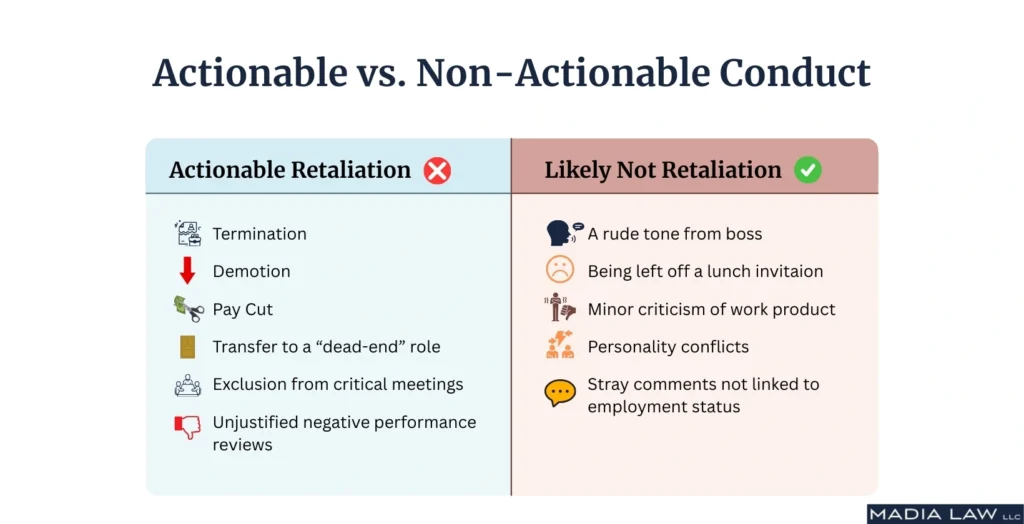
Retaliation is not always as obvious as a termination letter. In corporate environments like downtown Minneapolis, retaliation often looks like “death by a thousand cuts.”
However, not every annoyance counts. The Supreme Court has ruled that “petty slights and minor annoyances” are not illegal. To be actionable, the conduct must be significant enough to deter a reasonable person from complaining.
Common “Soft” Retaliation Tactics
- The Set-Up: You are suddenly assigned impossible deadlines or a workload designed to ensure you fail.
- The Freeze-Out: You are removed from email chains, client meetings, or key decision-making processes essential to your role.
- The Paper Trail: After years of positive reviews, you suddenly receive a Performance Improvement Plan (PIP) days after filing a complaint.
Click to contact our personal injury lawyers today
Proving Causation: The “Pretext” and the Lie
Employers rarely admit, “We fired him because he complained.” Instead, they will offer a legitimate, non-retaliatory reason, such as “poor performance,” “restructuring,” or “budget cuts.”
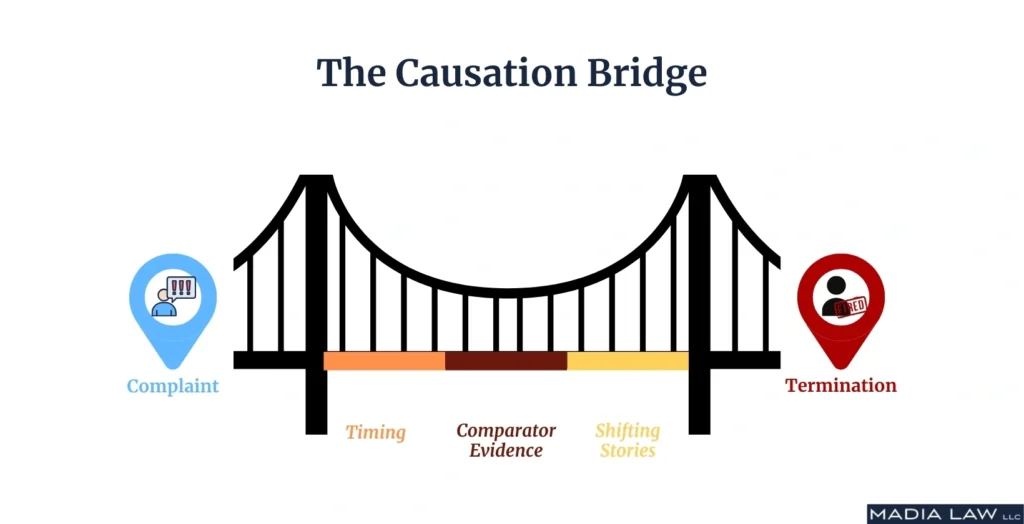
To win, we must prove that their stated reason is a pretext, a lie used to cover up their illegal motive. Here is how we prove pretext:
1. Temporal Proximity (Suspicious Timing)
If you made a complaint on Tuesday and were fired on Friday, the timing is highly suspicious. While timing alone isn’t always enough to win, close temporal proximity is strong circumstantial evidence of retaliation.
2. Comparator Evidence
We look at how other employees are treated.
- Example: You were fired for being five minutes late. However, your coworker “Bob,” who did not make a complaint, is late every day and has never been disciplined. This inconsistency suggests the lateness is a pretext for retaliating against you.
3. Shifting Explanations
Did the employer’s story change? First, they told you the position was being eliminated. Later, they told the EEOC you were fired for performance. When an employer cannot keep their story straight, it signals dishonesty.
4. Violation of Policy
If the employee handbook says a worker gets two warnings before termination, but you were fired immediately after a complaint without warning, the deviation from standard policy is evidence of retaliatory intent.
Complete a Case Evaluation form now
Evidence Checklist: Building Your Case
If you suspect retaliation, your primary job is to document everything. Strong evidence turns a “he-said, she-said” argument into a verifiable legal claim.
- Preserve the Timeline: Create a detailed log of events. Who said what, when, and where?
- Save Communications: Forward relevant emails to a personal account (if allowed by policy) or print them. Do not rely on having access to your work laptop forever.
- Digital Forensics: In litigation, we can often uncover “deleted” Slack messages, Teams chats, or metadata that reveals when documents were created or altered backdated.
Can I Record Conversations in Minnesota?
Yes, but be careful. Minnesota is a “one-party consent” state. This means you can legally record a conversation you are a part of without the other person’s permission.
Warning: While legal, it may still violate company policy. If your employer finds out, they could fire you for violating policy. Consult with an attorney before recording.
Minnesota vs. Federal Retaliation Laws
While federal laws like Title VII apply nationwide, Minnesota employees often have advantages under local statutes.
The Minnesota Human Rights Act (MHRA)
- Broader Coverage: The MHRA applies to smaller employers (1+ employees) compared to some federal laws (15+ employees).
- The “Reprisal” Standard: Minnesota law uses the term “reprisal” and has specific provisions that can sometimes offer easier paths to recovery than federal courts.
Where to File?
As of October 2025, the MDHR and EEOC no longer automatically cross-file charges. You must file separately with both agencies to preserve all your rights.
- EEOC (Federal): The deadline is typically 300 days in Minnesota. Essential for Title VII and ADA claims.
- MDHR (State): The deadline is one year (365 days). Essential for Minnesota Human Rights Act claims.
- Minnesota State Court: Under the 2024 amendments, you now have 90 days (increased from 45) to file suit after the MDHR dismisses a charge.
Important: Filing with one agency does not protect your rights with the other. If you intend to pursue both federal and state claims, you must manage and meet both deadlines.
Constructive Discharge: The Dangers of Resigning
Many employees ask, “They are making my life miserable. Can I just quit and sue?”
This is called Constructive Discharge, and it is legally difficult to prove. To win, you must prove that your employer deliberately made working conditions so intolerable that a reasonable person would feel compelled to resign.
Strategic Warning: If you resign, you may lose your right to back pay and unemployment benefits. Courts often rule that simple unfairness or stress isn’t intolerable. Do not resign without speaking to an employment law attorney mn first. We may be able to negotiate a severance package while you are still employed, which provides far more leverage.
Who Can Be Held Legally Liable?
Retaliation claims are generally filed against the employer (the company). However, liability depends on who knew what.
- Supervisors & Management: Employers are strictly liable for retaliation by supervisors that results in a tangible employment action (firing, pay cut).
- Coworkers: If a peer is harassing you because of a complaint, the employer is liable only if they knew about the harassment and failed to stop it.
- Third Parties: If a client or vendor demands your removal because of your protected status, and your employer complies, the employer is liable.
Real-World Examples: Madia Law Wins
We don’t just talk about retaliation; we fight it in court. While past results do not guarantee future outcomes, here is what proving retaliation looks like in practice:
- $2.4 Million Settlement for Gender Discrimination: Secured for a high-performing employee who was terminated after reporting systemic gender discrimination. We proved that her “opposition” to illegal practices, a heavily protected activity under the MHRA, was the true and only reason for her termination.
- $2.1 Million Jury Verdict on Retaliation for Race Discrimination Complaint: In a landmark case, a jury held an employer accountable for terminating our client after he reported concerns of race discrimination on behalf of a fellow employee. This $2.1 million judgment reinforces that “associational retaliation” is a serious violation of Minnesota law.
- $1.95 Million Settlement for Wrongful Termination: We represented four employees who were terminated after reporting sexual harassment and physical assault on the job. The company attempted to silence the victims rather than fix the culture. This settlement sent a clear message: Minnesota workers will not be punished for seeking a safe workplace.
- $1.1 Million Settlement for Reprisal: A client was terminated shortly after reporting discrimination. The employer claimed performance issues. We uncovered comparator evidence showing that other employees with similar performance records were promoted, not fired, proving the performance excuse was pretextual.
- $820,000 Settlement for Whistleblower: Our client, a high-level executive, reported financial improprieties. The company fired him, claiming restructuring. We utilized forensic evidence to prove the restructuring was a sham created solely to oust him.
What Remedies Are Available in Retaliation Cases?
Successful retaliation claims may result in reinstatement, back pay, front pay, emotional distress damages, policy changes, and attorneys’ fees under Minnesota and federal law. Available remedies depend on the statute invoked and the facts proven.
Frequently Asked Questions About Proving Retaliation
Is a Single Negative Action Enough to Prove Retaliation?
Yes, a single action can be enough if it is materially adverse. While a one-time rude comment is rarely enough, a single demotion, termination, or significant pay cut is sufficient to trigger a legal claim if linked to a protected activity.
What Are the Three Elements of Retaliation?
To prove retaliation, you must demonstrate: (1) You engaged in a protected activity, (2) You suffered a materially adverse action, and (3) There is a causal connection linking the activity to the punishment.
Is It Hard to Prove Retaliation in Court?
It can be challenging because direct evidence (I’m firing you for complaining) is rare. However, skilled Minneapolis retaliation attorneys successfully prove retaliation using circumstantial evidence, such as suspicious timing (temporal proximity), shifting employer explanations, and inconsistent discipline compared to coworkers.
What is the Statute of Limitations for Retaliation in Minnesota?
Under the Minnesota Human Rights Act, you generally have one year from the date of the retaliatory act to file a claim or a lawsuit. For federal claims with the EEOC, the deadline is typically 300 days in Minnesota.
Does a Negative Performance Review Count as Retaliation?
It depends. A negative review alone may not be actionable unless it leads to tangible consequences like denial of a bonus, a raise, or a promotion, or if it is part of a broader pattern of conduct designed to force you out.
Stop the Retaliation. Protect Your Career.
If you are facing an employer who is silencing you, you are up against powerful forces, HR departments, corporate legal teams, and management strategies designed to make you give up.
At Madia Law LLC, we specialize in beating giants. We know how to uncover the digital evidence and the pretext they try to hide.

Do not face this alone.
Get a Confidential Case Review
100% Confidential. No obligation. We will review your timeline and help you determine if you have a claim.
Call 612-349-2729 or complete a Case Evaluation form