The difference between exempt and non-exempt employees determines whether you are entitled to overtime pay. Exempt employees are paid a salary to do specific high-level duties and are not entitled to overtime pay. Non-exempt employees, even those paid a salary, must be paid overtime for hours worked over the legal threshold.
In Minnesota, your status isn’t decided by your job title or what your manager says. It is determined by strict federal and state laws involving how you are paid, how much you earn, and your daily duties. As of January 1, 2025, the federal salary threshold has increased significantly, meaning many workers previously classified as “exempt” may now be owed overtime pay.
Key Takeaways: Exempt Vs. Non-Exempt Status at a Glance
If you are non-exempt, you have the right to overtime pay. If you are exempt, you generally do not. To be exempt, an employer must prove you meet specific legal tests.
| Category | Exempt Employees | Non-Exempt Employees |
|---|---|---|
| Overtime Eligibility | Not entitled to overtime | Guaranteed overtime pay |
| Time Tracking | Not legally required | Employer must track all hours |
| Pay Structure | Fixed salary (must meet threshold) | Hourly or salaried |
| Legal Protection | Limited wage protections | Protected by minimum wage and overtime laws |
| Overtime Trigger | N/A | Over 48 hours/week (MFLSA) or 40 hours/week (FLSA) |
Why This Matters Now
- New Thresholds: You must generally earn at least $1,128 per week ($58,656 annually) to be exempt. If you earn less, you are likely non-exempt, regardless of your title.
- Job Titles Don’t Matter: Calling someone a “Manager” does not make them exempt if they spend their day stocking shelves or performing manual labor.
- “Salaried” Does Not Mean “Exempt”: This is the most common myth. You can receive a salary and still be entitled to overtime if you don’t meet the legal duties tests.
For a legal consultation, call 612-349-2729
What is an Exempt Employee?
To be exempt, an employee must satisfy a three-pronged test under the FLSA:
- The Salary Basis Test (fixed pay),
- The Salary Level Test (minimum weekly earnings), and
- The Duties Test.
If any prong fails, the employee is non-exempt by default. Titles are legally irrelevant; “Administrative Assistant” and “Executive” mean nothing if the daily tasks don’t involve high-level discretion or management.
| Pros | Cons |
|---|---|
| Predictable, stable income | No pay for 60+ hour workweeks. |
| Professional autonomy. | High responsibility/liability. |
The 3-Step Test: Are You Exempt?
To be legally classified as exempt under the Fair Labor Standards Act (FLSA), your employer must prove that your role meets all three of the following requirements. If you fail even one, you are non-exempt.

1. The Salary Basis Test
You must be paid a predetermined, fixed salary that is not subject to reduction because of variations in the quality or quantity of work performed. Generally, if you take a partial sick day, your pay cannot be docked.
2. The Salary Level Test (2025 Update)
Under the FLSA rule effective January 1, 2025, you must earn at least $1,128 per week (approx. $58,656 per year).
- Previous Rule: The old threshold was $684/week. If you earn between $35,568 and $58,656, your status may have recently changed to non-exempt.
- Highly Compensated Employees (HCE): If you earn $151,164 or more annually, a more relaxed duties test applies.
3. The Duties Test
Your primary duty must be the performance of exempt work. The most common “White Collar Exemptions” include:
- Executive: You manage the enterprise or a department, supervise at least two full-time employees, and have genuine input on hiring/firing.
- Administrative: You perform non-manual office work directly related to management or business operations and exercise independent judgment on significant matters.
- Professional: Your work requires advanced knowledge in a field of science or learning (e.g., doctors, lawyers, engineers).
- Outside Sales: You regularly work away from the employer’s place of business to make sales.
Click to contact our personal injury lawyers today
What is a Nonexempt Employee?
A non-exempt employee is entitled to minimum wage and overtime pay. Most workers in the United States are non-exempt.
| Pros | Cons |
|---|---|
| Direct pay for extra effort. | Income can drop if hours are cut. |
| Strict legal protections. | Micro-managed timekeeping. |
Can a Non-Exempt Employee Be Salaried?
Yes. This is often called “Salaried Non-Exempt.” Your employer pays you a guaranteed salary, but they must still track your hours.
- If you work over 40 hours (Federal) or 48 hours (Minnesota), they must pay you overtime on top of your salary.
- Overtime is calculated based on your Regular Rate of Pay, which converts your salary to an hourly equivalent for the workweek.
Rights of Non-Exempt Workers
- Overtime Pay: 1.5 times your regular rate for overtime hours.
- Time Accuracy: Employers cannot ask you to work “off the clock” or edit your time sheets to avoid overtime.
- Gap Time: You must be paid for all hours worked, even if they don’t trigger overtime.
Complete a Case Evaluation form now
Minnesota vs. Federal Rules: Understanding “Gap Time”
This is where many Minnesota employers get it wrong. Two different laws cover Minnesota workers: the federal FLSA and the Minnesota Fair Labor Standards Act (MFLSA).
- Federal FLSA: Requires overtime after 40 hours in a work/week.
- Minnesota Law: Requires overtime after 48 hours in a work/week.
Which Rule Applies?
In almost all cases involving interstate commerce (which covers most businesses), the federal 40-hour rule applies because it is more favorable to the employee.
However, a legal nuance exists called “Gap Time.” If you are covered by Minnesota law but not federal law (rare, but possible in very small, local businesses), you might only get overtime after 48 hours. If you work 45 hours, those extra 5 hours are paid at straight time, not time-and-a-half.
Madia Law LLC frequently sees cases where employers try to apply the 48-hour Minnesota rule to avoid paying overtime after 40 hours. If your business accepts credit cards or buys goods from out of state, the 40-hour federal rule likely protects you.
Common Myths About Workplace Rights
Employers often confuse “exempt status” with company perks. Your legal classification does not determine your right to breaks or benefits.
| Myth | Fact |
|---|---|
| “I’m salaried, so I don’t get overtime.” | False. Salary is just a pay method. If your duties or pay level don’t meet the law, you get overtime. |
| “I have a manager title.” | Irrelevant. If you spend most of your time making coffee or stocking shelves, you’re likely non-exempt. |
| “Exempt staff don’t get breaks.” | False. Minnesota break laws apply to employees generally. |
| “Comp time replaces overtime.” | Illegal for private employers. You generally can’t “bank” hours for next week to avoid paying overtime. |
Note on Minnesota Break Laws (2025/2026)
Starting in 2026, stricter break requirements have gone into effect statewide (Minn. Stat. § 177.253). Employers must provide adequate time to use the restroom and sufficient time to eat a meal.
Regardless of whether you are exempt or non-exempt:
- Breaks under 20 minutes must be paid and counted as hours worked.
- Meal breaks must be long enough to actually eat; if you are forced to work through it, you must be paid.
Can My Employer Change Me From Exempt to Non-Exempt?
Yes, and they often should. Employers frequently reclassify employees to comply with new laws (like the 2025 salary increase) or following a legal audit.
- If you are reclassified as non-exempt: It is not a demotion. It means you are now eligible for overtime pay. Your employer must start tracking your hours.
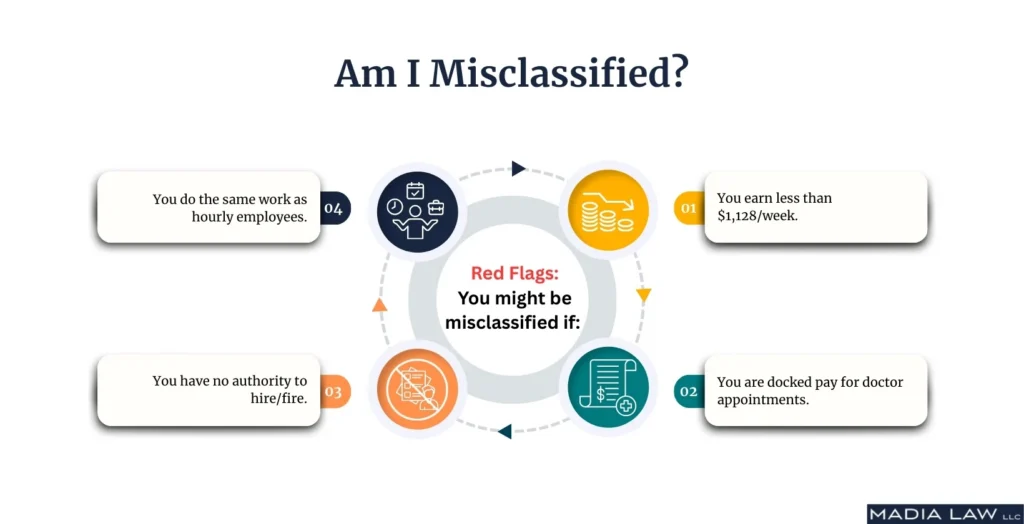
- Red Flag: If your employer reclassifies you as exempt but your duties haven’t changed and you didn’t get a raise, they may be trying to avoid paying you overtime.
If you are reclassified, ask for:
- An updated written pay agreement.
- A new job description reflecting your actual duties.
- Confirmation of how your “regular rate” will be calculated for overtime.
Consequences of Misclassification (What You Can Recover)
If you have been misclassified as exempt when you should be non-exempt, your employer has committed wage theft. You may be entitled to recover significantly more than just your hourly pay.
Damages typically include:
- Back Pay: Unpaid overtime wages going back 2 years (or 3 years for willful violations).
- Liquidated Damages: Under federal law, you are often entitled to “double damages.” If your employer owes you $10,000 in overtime, the court may award you another $10,000 as a penalty.
- Attorneys’ Fees: The law forces the employer to pay your legal fees if you win, allowing firms like Madia Law LLC to represent workers on a contingency basis.
How Madia Law LLC Can Help You
If you suspect you are working for free, you need a firm that is trial-ready. Many firms look for quick settlements, but Madia Law LLC prepares every case as if it will go to trial. This aggressive approach maximizes value for our clients.
Our Process for Wage Claims:
- Forensic Audit: We review your pay stubs, job descriptions, and emails to prove your actual duties.
- Damage Calculation: We calculate the “Regular Rate of Pay” to determine exactly what you are owed, including gap time and liquidated damages.
- Confidential Advocacy: We protect you against retaliation. It is illegal for an employer to fire or punish you for asserting your rights under the FLSA or MFLSA.
Our Minneapolis employment lawyers have successfully recovered millions for workers, including a $1.1 Million settlement in a recent whistleblower and wage case.
Note: We operate on a contingency fee basis for wage claims. You pay no legal fees unless we recover money for you.
Don’t Work for Free. Verify Your Status Today.
If you are working long hours without overtime pay, do not assume your employer has classified you correctly. Mistakes are common, and intentional misclassification is a frequent tactic to cut costs.
Take the next step:
- Check your pay stub: Do you earn less than $1,128/week?
- Review your duties: Do you actually manage people, or just execute tasks?
- Contact us: We can determine if you are owed back pay and damages.

Request My Free Confidential Case Evaluation
FAQs About Exempt vs Non-Exempt Employees
Is It Better To Be an Exempt Or Non-Exempt Employee?
It depends on your role. Exempt employees get salary stability but no overtime pay. Non-exempt employees earn overtime, but must track hours. The better status depends on your hours, job duties, and how you prefer to be paid.
Do Salaried Employees Get Overtime in Minnesota?
Yes, often. Being “salaried” does not automatically make you exempt. If you are a salaried employee who earns less than $58,656/year OR does not perform specific management duties, you are entitled to overtime pay for hours worked over 40 (or 48) per week.
Does Exempt Always Mean Salary?
No. Exempt does not always mean salary. You must meet all three exemption tests: salary basis, salary level, and duties. Being salaried is one part, but it doesn’t guarantee exemption status.
What is the Minimum Salary for Exempt Employees in Minnesota in 2025?
As of January 1, 2025, the standard federal salary threshold is $1,128 per week ($58,656 annually). Most Minnesota employers must follow this federal standard because it is higher than the state threshold.
Can A Part-Time Employee Be Exempt?
Technically, yes, but it is rare. To be exempt, a part-time employee would still need to meet the full weekly salary threshold ($1,128/week) and perform exempt duties. Prorating the salary usually disqualifies the exemption.
Are Independent Contractors Exempt Or Nonexempt?
Neither. Independent contractors are not classified as exempt or nonexempt. FLSA overtime rules do not cover them, but some are misclassified employees in disguise.
Can Nonexempt Employees Be Salaried?
Yes. Nonexempt employees can be salaried. As long as they’re paid overtime for hours worked beyond the legal threshold, salary alone doesn’t make them exempt.
What are “Liquidated Damages” in a Wage Case?
Liquidated damages are a penalty awarded to employees equal to the amount of unpaid wages. Essentially, if your employer failed to pay you for overtime, they may have to pay you double the amount owed to compensate for the delay.
Does PTO Count Toward Overtime in Minnesota?
No. Overtime is calculated based on hours actually worked. Paid Time Off (PTO), holidays, and sick leave do not count toward the 40-hour or 48-hour overtime threshold.
Call 612-349-2729 or complete a Case Evaluation form